Some newcomers are confused when they listen to conversations and partially it is because we, as 1st language English speakers, use thousands of phrasal verbs.
There is a previous post about phrasal verbs.
Essentially they are verbs that change their meaning with the addition of a preposition.
Here are some examples:
think of the verb BREAK - everyone knows this meaning
now add the preposition UP
BREAK UP - now the meaning has changed to: ending a relationship
so different from the verb BREAK
Here is an excellent website to help you FIGURE OUT more phrasal verbs:
http://www.eslcafe.com/pv/pv-b.html
If you have questions, WRITE THEM OUT....
send an email, we'll help
Thursday, July 28, 2011

Thursday, July 21, 2011
LISTENING PRACTICE!
This blog has had a lot of reading and writing practice and all the students tell teachers that they need listening practice.
Newcomers have difficulties hearing specific words and understanding North American accents.
Well, here is an excellent website for everyone.
You can listen, read along and then do activities after you watch and listen to the short videos.
http://www.esl-lab.com/
On the left hand side of the window, you'll see "Watch Culture Videos"
CLICK on this and then choose a topic.
Good luck and enjoy the website. It is used by many teachers and students.
Again, if you have any questions, please email us.


Newcomers have difficulties hearing specific words and understanding North American accents.
Well, here is an excellent website for everyone.
You can listen, read along and then do activities after you watch and listen to the short videos.
http://www.esl-lab.com/
On the left hand side of the window, you'll see "Watch Culture Videos"
CLICK on this and then choose a topic.
Good luck and enjoy the website. It is used by many teachers and students.
Again, if you have any questions, please email us.
Wednesday, July 13, 2011
The Seasons
Canada has four seasons although in Ontario, some people say it has 2; construction and winter.
Each season is beautiful and remarkable for many different reasons including the winter. Winter is especially difficult for newcomers who may be unaccustomed to the drop in weather temperatures.
There is a special need to be prepared for winter as it could be potentially dangerous.
What would you recommend to a newcomer to buy for the winter?
Summer can be very humid depending on where you live.
Here are some terms to look up:
humidex
wind chill
sleet
hail
white out
black ice
hazy
scorching
The weather channel is also a very good source for anyone wanting to learn more vocabulary.
Send us your comments, questions.
How can you compare the seasons in your home country with those in Canada?

Each season is beautiful and remarkable for many different reasons including the winter. Winter is especially difficult for newcomers who may be unaccustomed to the drop in weather temperatures.
There is a special need to be prepared for winter as it could be potentially dangerous.
What would you recommend to a newcomer to buy for the winter?
Summer can be very humid depending on where you live.
Here are some terms to look up:
humidex
wind chill
sleet
hail
white out
black ice
hazy
scorching
The weather channel is also a very good source for anyone wanting to learn more vocabulary.
Send us your comments, questions.
How can you compare the seasons in your home country with those in Canada?

Sunday, July 3, 2011
O Canada!
July 1st was Canada Day! The best country in the world!
Here are the lyrics for all of the newcomers to our great country.....

Here are the lyrics for all of the newcomers to our great country.....
O Canada!
Our home and native land!
True patriot love in all thy sons command.
Our home and native land!
True patriot love in all thy sons command.
With glowing hearts we see thee rise,
The True North strong and free!
The True North strong and free!
From far and wide,
O Canada, we stand on guard for thee.
O Canada, we stand on guard for thee.
God keep our land glorious and free!
O Canada, we stand on guard for thee.
O Canada, we stand on guard for thee.
O Canada, we stand on guard for thee.
Tuesday, June 28, 2011
Phrasal Verbs
Recently, I was speaking with a newcomer who said that the reason he had failed an advanced English proficiency exam was because he lacked using phrasal verbs.
English uses thousands of them all the time. It is so important to know some of the more common phrasal verbs.
A good way to find out what some of them might be is to read a newspaper in an English speaking country. In the headlines you will see phrasal verbs, slang and idioms. Beware however because headlines change the tense to simple present and eliminate prepositions and articles. Also, sometimes one idiom is blended with another. In any case, reading a newspaper is excellent practice.
There is also a very good website for all things grammar. It is:
www.theenglishclub.com
Here is a sampling of what this website has about phrasal verbs:
English uses thousands of them all the time. It is so important to know some of the more common phrasal verbs.
A good way to find out what some of them might be is to read a newspaper in an English speaking country. In the headlines you will see phrasal verbs, slang and idioms. Beware however because headlines change the tense to simple present and eliminate prepositions and articles. Also, sometimes one idiom is blended with another. In any case, reading a newspaper is excellent practice.
There is also a very good website for all things grammar. It is:
www.theenglishclub.com
Here is a sampling of what this website has about phrasal verbs:
Phrasal Verbs and other multi-word verbs
Phrasal verbs are part of a large group of verbs called "multi-word verbs". Phrasal verbs and other multi-word verbs are an important part of the English language. Multi-word verbs, including phrasal verbs, are very common, especially in spoken English. A multi-word verb is a verb like "pick up", "turn on" or "get on with". For convenience, many people refer to all multi-word verbs as phrasal verbs. These verbs consist of a basic verb + another word or words. The other word(s) can be prepositions and/or adverbs. The two or three words that make up multi-word verbs form a short "phrase" - which is why these verbs are often all called "phrasal verbs".
The important thing to remember is that a multi-word verb is still a verb. "Get" is a verb. "Get up", is also a verb, a different verb. "Get" and "get up" are two different verbs. They do not have the same meaning. So you should treat each multi-word verb as a separate verb, and learn it like any other verb. Look at these examples. You can see that there are three types of multi-word verb:
| single-word verb | look | direct your eyes in a certain direction | You must look before you leap. | |
| multi-word verbs | prepositional verbs | look after | take care of | Who is looking after the baby? |
| phrasal verbs | look up | search for and find information in a reference book | You can look up my number in the telephone directory. | |
| phrasal-prepositional verbs | look forward to | anticipate with pleasure | I look forward to meeting you. | |
Why does English use phrasal verbs? Why indeed! Possibly because phrasal verbs use less words to communicate an idea.
Again, if you have any questions, please email and we will attempt to answer them all.
Monday, June 20, 2011
Family
It was just Father's Day so this entry will be related to vocabulary about families!
Why do we have Father's Day? Try to find out the answer....
For the male (men and boys) members of your family:
great-grandfather
grandfather
father
uncle
brother
nephew
son-in-law
stepson
adopted son
son
half brother
ANY MISSING?
For the female members of your family (women, girls)
great-grandmother
grandmother
mother
sister
niece
sister-in-law
adopted sister
half sister
stepsister
daughter
Here are some other words to look up at: www.thefreedictionary.com
nuclear family
extended family
Have you tried to make a family tree? If you go to Google type in family tree.
What are some adjectives you could use to describe your father?
If you have any questions, thoughts or ideas, please email us and one of the teachers will answer your questions.
Hope everyone had a happy Father's Day!

Why do we have Father's Day? Try to find out the answer....
For the male (men and boys) members of your family:
great-grandfather
grandfather
father
uncle
brother
nephew
son-in-law
stepson
adopted son
son
half brother
ANY MISSING?
For the female members of your family (women, girls)
great-grandmother
grandmother
mother
sister
niece
sister-in-law
adopted sister
half sister
stepsister
daughter
Here are some other words to look up at: www.thefreedictionary.com
nuclear family
extended family
Have you tried to make a family tree? If you go to Google type in family tree.
What are some adjectives you could use to describe your father?
If you have any questions, thoughts or ideas, please email us and one of the teachers will answer your questions.
Hope everyone had a happy Father's Day!
Tuesday, June 7, 2011
The Weather in Canada!
Lately we've been having crazy weather here in Ontario.
What's the explanation? Why? Some say global warming and some say that it's because we live in Canada.
One thing we do not for certain is that Canadians love to talk about the weather.
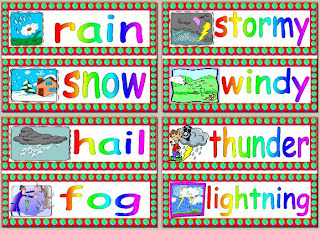
What's the explanation? Why? Some say global warming and some say that it's because we live in Canada.
One thing we do not for certain is that Canadians love to talk about the weather.

Here are some English idioms that use the weather.
a face like thunder = to look very angry: "What's up with him today? He has a face like thunder!"
a face like thunder = to look very angry: "What's up with him today? He has a face like thunder!"
a fair-weather friend = a friend who doesn't support you in bad times: "I'm a bit disappointed in John and David. It turned out they were only fair-weather friends."
a snowball's chance = very little chance (as much chance as a snowball has in hell): "We don't have a snowball's chance of winning that contract!"
a storm in a teacup = a lot of fuss over something small: "Don't worry about those two arguing. it's just a storm in a teacup."
be a breeze = to be easy: "The exam was a breeze."
be snowed under = to be very busy: "We're snowed under at work."
blow hot and cold = to keep changing your attitude: "They're blowing hot and cold over this issue. It's impossible to know what they want!"
brass-monkey weather = very cold weather: "It's brass-monkey weather today. You'd better wrap up warm!"
come rain or shine = whatever happens: "He's always working in his garden – come rain or shine."
the lull before the storm = a quiet time before a busy or difficult time: "It's going to get very busy on Thursday. Today and tomorrow are just the lull before the storm."
save up for a rainy day = put money aside for when you might need it later: "I don't want to spend this extra money. I'll save it up for a rainy day."
see which way the wind blows = to analyse a situation before doing something: "I'm going to see which way the wind blows before asking her about a raise."
steal someone's thunder = do what someone else was going to do and get all the praise: "You'll steal her thunder if you wear that dress tonight!"
take a rain check = postpone something: "I don't really want to go the cinema tonight. Can we take a rain-check on it?"
under the weather = not feel very well: "I'm feeling a bit under the weather at the moment."
weather the storm = to survive a difficult situation: "This recession is quite serious and it's becoming difficult to weather the storm."
Subscribe to:
Posts (Atom)